
The Future of Data Centers: The Hidden Technology Powering Our Digital World
Blog Introduction
Every time someone streams a video, makes an online payment, uses an AI assistant, or accesses a business application, an enormous amount of computing happens behind the scenes.
We see the screen. We rarely see the infrastructure making it work.
At the center of this digital experience are data centers — the specialized, mission-critical facilities that store, process, and manage the information powering modern businesses and everyday technology.
But data centers are entering a new phase of historic transformation. Artificial intelligence is exponentially multiplying the demand for computing power, businesses are processing unprecedented data volumes, and energy efficiency has emerged as a paramount engineering challenge.
The next generation of data centers will not simply be larger warehouse facilities. They will need to be smarter, faster, more energy-efficient, and dynamically adaptable to shifting computational demands.
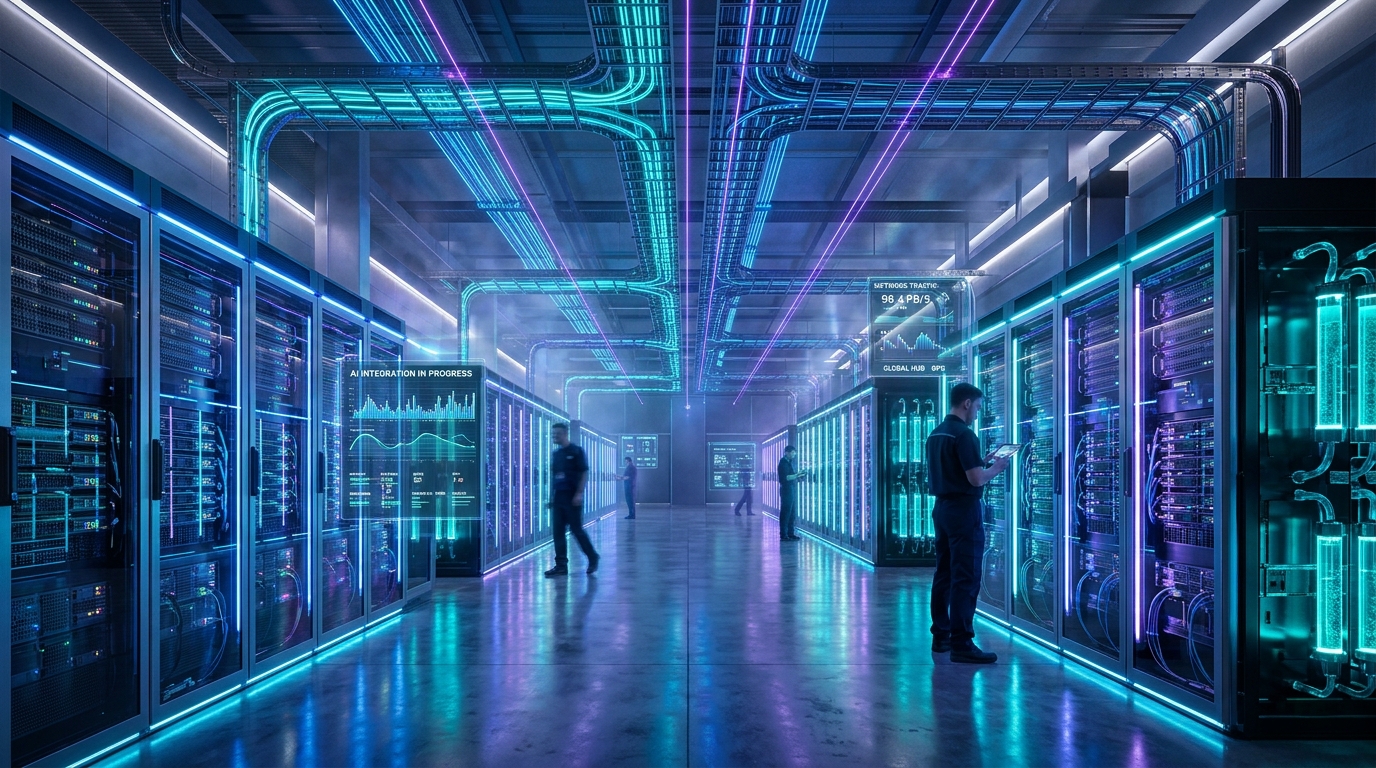
Quick Summary: Modern data centers are evolving from static server warehouses into living, intelligent computational ecosystems. Driven by massive AI density, direct-to-chip liquid cooling, autonomous edge architectures, and predictive software orchestration, tomorrow's infrastructure balances raw compute throughput with radical energy stewardship.
Main Article
Why Data Centers Matter More Than Ever
Modern businesses depend on digital infrastructure for almost everything.
Customer databases, customer-facing websites, cloud SaaS platforms, enterprise resource planning (ERP) suites, payment processing gateways, communication tools, and AI-powered services all require reliable computing infrastructure.
As digital operations expand, the infrastructure supporting them must evolve too.
Traditional data center designs were primarily built around predictable workloads, conventional x86 servers, and established raised-floor air-cooling systems. However, modern workloads — particularly artificial intelligence and high-performance computing (HPC) — create fundamentally different physical and thermal demands.
They require greater processing capacity, faster data movement, efficient power distribution, and advanced thermal management.
This is changing how modern data centers are engineered, operated, and maintained from the ground up.
Key Insight: Data center capacity is no longer measured solely in square footage or raw server counts—it is now governed by power density (kW per rack), thermal dissipation efficiency, and ultra-low-latency interconnect throughput.
AI Is Reshaping Data Center Architecture
Artificial intelligence is one of the biggest forces influencing the future of data centers.
Training and running advanced AI models requires powerful specialized processors, high-speed networking fabrics (such as InfiniBand and 800G Ethernet), and massive memory bandwidth. These workloads can generate significantly more heat and consume exponentially more electricity than many conventional computing tasks.
As a result, data center architecture is rapidly evolving:
- Specialized AI Accelerators & High-Performance GPUs: Replacing general-purpose compute with specialized matrix-math silicon.
- Ultra-High Density Racks: Power density per rack is climbing from conventional 10-15 kW per rack to over 40-100 kW per rack in modern AI clusters.
- Direct-to-Chip Liquid Cooling: Traditional air cooling is physically incapable of removing heat from 1000W+ chips. Liquid cooling technologies, which circulate dielectric fluids or treated water directly across cold plates on high-power components, are becoming standard for demanding workloads.
- High-Speed Interconnects: Reducing bottlenecks between distributed GPU nodes to avoid compute stall cycles during large model training runs.
The goal is not simply to install more powerful hardware. It is to create an engineered environment where that hardware can operate reliably, sustainably, and efficiently over years of uninterrupted computation.
Comparing Traditional vs Next-Gen AI Data Centers
To understand how rapidly technology is advancing, consider how next-generation facilities contrast with historical designs:
| Architectural Dimension | Traditional Data Centers (Pre-2023) | Next-Gen AI Data Centers (2026+) |
|---|---|---|
| Primary Workloads | Static web servers, databases, general virtualization | LLM training, AI inference, real-time computer vision |
| Rack Power Density | 5 kW to 15 kW per rack | 40 kW to 120+ kW per high-density rack |
| Thermal Management | Computer Room Air Handlers (CRAH) & chiller loops | Direct-to-chip liquid cooling & immersion cooling |
| Network Fabric | Standard 10G/40G/100G Leaf-Spine Ethernet | 400G/800G InfiniBand & RoCE with ultra-low latency |
| Operational Control | Manual scheduling & reactive threshold alerts | Autonomous AI-driven thermal & predictive load rebalancing |
| Sustainability Metric | PUE 1.5 - 1.8 with high evaporative water consumption | Target PUE < 1.15, closed-loop liquid, 100% renewable matching |
The Shift Towards Intelligent Infrastructure
The next generation of data centers will increasingly rely on software to manage physical infrastructure.
Modern infrastructure management systems can continuously monitor server performance, junction temperatures, power distribution unit (PDU) loads, storage capacity, and network queue activity.
With automation and AI-assisted telemetry, facility operators can identify subtle operational anomalies, predict component degradation before catastrophic failure, and dynamically optimize resource allocation in real time:
- Predictive Thermal Safeguards: A monitoring system can detect an abnormal micro-increase in thermal resistance on a specific server blade. Instead of waiting for thermal throttling or hardware failure, the system automatically routes tasks to cooler racks and alerts technicians.
- Intelligent Workload Scheduling: High-compute batch jobs can be scheduled dynamically when renewable grid power is cheapest and outdoor ambient air is coldest, dramatically shrinking carbon footprints and operational costs.
- Self-Healing Infrastructure: Redundant network paths and container orchestration platforms automatically reroute live traffic around impaired nodes with zero downtime.
This creates a seamless relationship between software algorithms and physical infrastructure. The data center is no longer just a collection of machines; it is an increasingly coordinated, self-optimizing computing organism.
Edge Computing: Bringing Processing Closer to Users
Not every digital service can depend entirely on distant, centralized hyperscale data centers.
Some applications require sub-millisecond, instantaneous physical responses. Industrial automation, connected autonomous vehicles, smart city grids, real-time video analytics, and critical healthcare monitoring are prime examples where processing delays can lead to operational failures.
Edge computing directly addresses this challenge by moving dedicated processing nodes geographically closer to where data originates:
- Latency Elimination: Moving processing from remote cloud regions (50-100ms roundtrip) to local edge micro-facilities (<5ms roundtrip).
- Bandwidth Conservation: Filtering and analyzing gigabytes of raw sensor and video data locally, transmitting only relevant summary events back to central databases.
- Operational Resiliency: Enabling local facilities to continue operating seamlessly even during temporary upstream Internet backbone interruptions.
Centralized hyperscale cloud infrastructure and distributed edge computing are not competing paradigms. They are complementary layers of a resilient, distributed digital infrastructure architecture.
Energy Efficiency Will Define the Next Generation
More computing power inevitably creates greater pressure on global energy resources.
Data centers require electricity not only to operate computational silicon, but also to power cooling pumps, networking switches, storage arrays, backup uninterruptible power supplies (UPS), and facility security systems.
This makes energy efficiency and Power Usage Effectiveness (PUE) the defining metric of modern facility engineering:
1. Advanced Liquid Cooling Adoption: Transitioning from energy-hungry air chilling compressors to closed-loop liquid systems that reject heat at higher temperatures with minimal energy consumption.
2. Waste Heat Reclamation: Capturing the thermal energy generated by server racks to heat local district residential networks or municipal greenhouses.
3. Renewable Energy Synchronization: Locating facilities adjacent to abundant geothermal, hydroelectric, and solar supplies, utilizing battery storage to smooth intermittent supply.
4. Silicon Efficiency: Shifting towards specialized ARM architectures and custom ASICs that deliver higher FLOPS per watt than legacy hardware.
The fundamental engineering challenge is to deliver exponentially more computing capability without allowing energy consumption and operating costs to spiral out of control. In the modern era, efficiency is performance.
Data Centers Are Becoming More Connected
The future of digital infrastructure is unlikely to depend on one monolithic facility doing everything.
Instead, modern enterprises will increasingly operate across an interconnected hybrid fabric combining public cloud hyperscalers, private dedicated facilities, regional edge nodes, and on-premise hardware:
- Workload Placement Strategy: Enterprises deploy scalable, elastic applications in the public cloud, maintain sensitive proprietary data in secure private environments, and execute real-time operations on local edge servers.
- Cybersecurity & Sovereign Compliance: Complying with localized data privacy laws (GDPR, DPDP) by routing and storing citizen records within designated geographic boundaries.
- Unified Observability: Managing multi-cloud and hybrid environments through centralized observability platforms that monitor latency, security postures, and resource costs across all locations.
The defining breakthrough of this decade is not simply building larger facilities. It is engineering the software and networking pipelines that allow disparate computing environments to operate as one unified, resilient fabric.
What This Means for Businesses
Data center innovation directly impacts how businesses build, deploy, and scale their software products:
- Application Performance & User Retention: Fast server response times directly translate to higher Google rankings, lower user bounce rates, and increased conversion rates.
- Cost Efficiency & Margin Control: Optimizing compute architecture and selecting the right cloud configurations prevents runaway infrastructure cloud bills.
- Scalability for Emerging AI Technologies: Companies with modern, flexible architectures can rapidly adopt generative AI, automated workflows, and data pipelines without rebuilding their entire core platform.
- Business Continuity & Disaster Recovery: Multi-region, distributed architectures guarantee continuous operations even in the event of local hardware or network disruptions.
Choosing the right digital infrastructure is no longer merely a back-office IT decision—it is a foundational business strategy that determines competitive agility and long-term market dominance.
At Sanmora Software Development and Cloud Solutions, we help forward-thinking enterprises design and engineer modern digital platforms that leverage scalable, high-performance cloud infrastructure built for future growth.
The Future Is Not Just More Computing Power
Data centers are evolving from static server rooms into intelligent, interconnected computational ecosystems.
Artificial intelligence is multiplying processing requirements. Edge computing is decentralizing compute closer to users. Advanced liquid cooling is conquering thermal boundaries, while autonomous software is making facility operations smarter and more reliable.
These advancements demonstrate a future where software, silicon, networking, energy management, and intelligent automation operate in complete harmony.
The digital experiences people use every day may feel effortless and instant on their screens, but the physical infrastructure making them possible is becoming more sophisticated by the day.
And as technology continues to push forward, the future of digital innovation will depend not only on the software applications we build, but on the infrastructure powerful enough to support them.