The End of Traditional Software? How the Next Generation of Applications Will Work Differently
Blog Introduction
For decades, software has worked in a fairly predictable way.
You open an application, find the feature you need, enter information, click a button, and wait for the system to respond. Whether it is a CRM, accounting platform, inventory system, website dashboard, or internal business application, the basic relationship has remained almost the same: the user tells the software what to do, and the software responds.
That model is not disappearing overnight.
But it is changing.
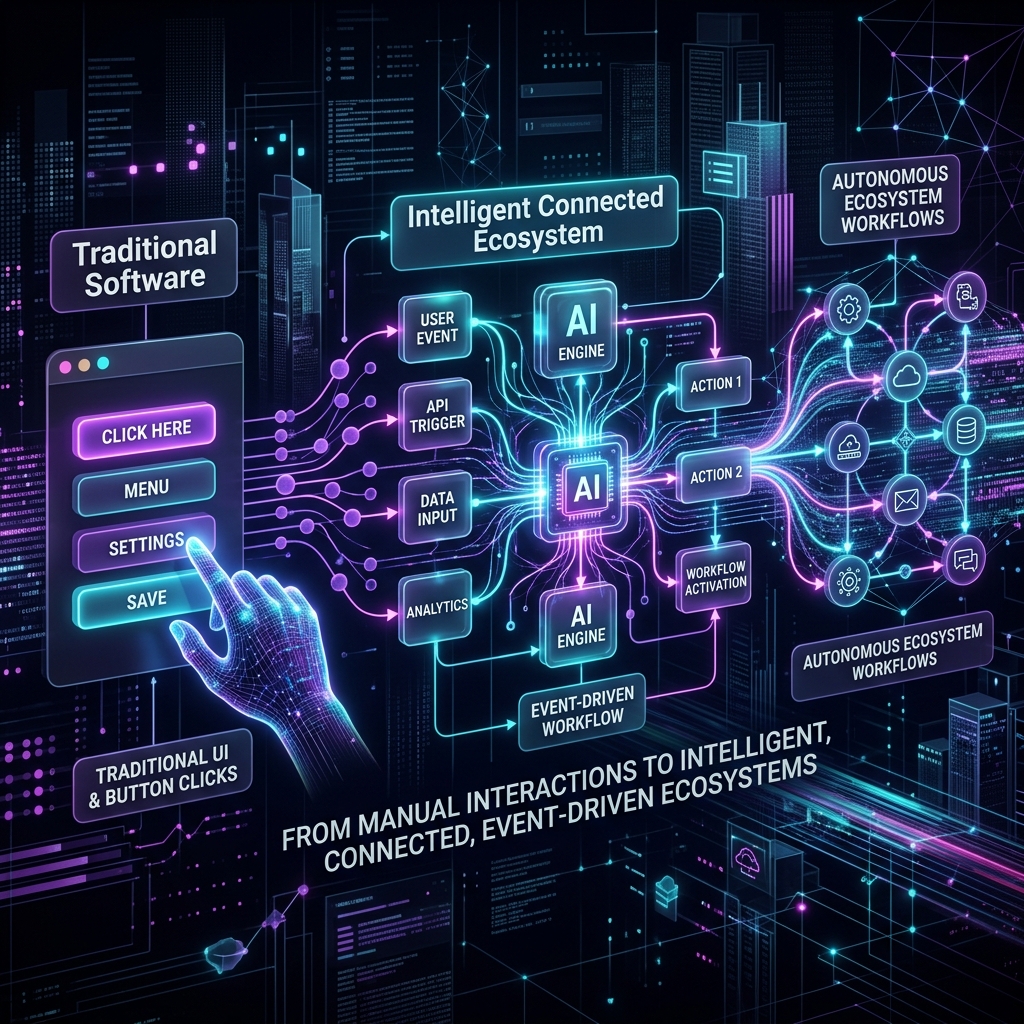
The next generation of software is being built around a different idea — applications that are more connected, more responsive to events, more aware of context, and capable of handling complete workflows rather than simply performing individual actions.
The question, therefore, is not whether traditional software will suddenly disappear.
The more interesting question is:
What will software look like when applications are designed to work with the business, rather than simply being tools used by the business?
Quick Summary: Traditional software requires human manual coordination across isolated screens. The next generation of software is shifting toward outcome-based, event-driven, and context-aware connected ecosystems that actively participate in business workflows.
Main Article
From Clicking Buttons to Completing Outcomes
Most traditional applications are designed around features.
If you want to create a customer, there is an Add Customer option. If you want to create an invoice, there is a Create Invoice option. If you want to schedule a follow-up, you open the relevant section and enter the required information.
This works well, but it puts the responsibility of connecting individual actions on the user.
Modern software is moving toward a more outcome-oriented approach.
Imagine a sales manager saying:
“Create a follow-up for this customer, notify the assigned employee, and remind the team if there is no response.”
Instead of treating these as three separate tasks, a modern application can be designed to understand the workflow behind the request and coordinate the required actions.
This is an important shift.
The software is no longer just providing a collection of buttons. It is becoming part of the process itself.
Software That Responds to Events
Another major change is the growing importance of event-driven applications.
Traditional systems often wait for a user to initiate an action. Modern systems can respond when something happens inside or outside the application.
For example:
A customer submits an enquiry on a website.
That event can trigger a chain of actions:
Website enquiry → CRM entry → Sales notification → Assignment → Follow-up → Customer communication
The individual systems may still exist, but they can work together as one connected workflow.
The same idea can apply to payments, inventory, bookings, logistics, customer support, employee workflows and many other business processes.
This makes software less dependent on constant manual intervention.
The Application Is No Longer an Island
One of the biggest limitations of older software environments is isolation.
A business may have a website, CRM, accounting system, inventory software, communication platform and payment system — but each system may maintain its own data and workflow.
Employees then become the connection between those systems.
They copy information from one application to another. They update records manually. They check whether another department has completed its part of a process.
This creates unnecessary work and increases the possibility of errors.
The next generation of applications is increasingly being designed as connected ecosystems.
* A website can communicate with a CRM.
* A CRM can communicate with a billing system.
* A payment event can update an order.
* An inventory change can trigger a notification.
* A customer action can update multiple parts of the business at once.
The goal is not simply to have more software.
The goal is to make existing software work together better.
Context Will Become More Important
A modern application should not only know what a user is doing. It should increasingly be able to work with the information surrounding that action.
Consider a customer who has contacted a business several times.
A simple application may show the customer's name, phone number and current order.
A more advanced system can bring together relevant context — previous interactions, open requests, order history, pending payments, previous follow-ups and other business information — within the same workflow.
This changes the experience for employees.
Instead of searching across multiple screens to understand a situation, the application can present the information that matters at the right moment.
This is where software becomes more useful without necessarily becoming more complicated.
The Screen May Not Always Be the Main Interface
For years, applications have been designed around screens.
Menus, dashboards, forms, tables and buttons have become the standard language of software.
That will continue to be important.
But it will no longer be the only way people interact with applications.
Voice interfaces, conversational interactions, mobile devices, connected hardware and other forms of interaction are becoming increasingly practical.
A business employee may not always need to navigate through five different screens to perform a simple task.
In the right environment, they could describe what they need and let the system handle the underlying workflow.
This does not mean every application needs a chatbot or voice assistant.
It means the definition of a software interface is becoming broader.
Cloud, Edge and Connected Devices Are Expanding What Software Can Do
The evolution of applications is also closely connected to the infrastructure running behind them.
Cloud computing has made it easier for applications to scale and communicate across locations. At the same time, edge computing allows certain processing tasks to happen closer to where data is generated.
Connected devices are adding another dimension.
A software system can receive information from sensors, machines, scanners, cameras or other hardware and use those events as part of a larger workflow.
For businesses, this creates possibilities beyond traditional web applications.
Software can become connected to the physical world.
* A machine status can trigger an alert.
* A stock level can trigger a procurement workflow.
* A device event can update a business dashboard.
* A physical event can become a digital action.
The boundary between software and the real world is becoming less rigid.
What Happens to Traditional Business Applications?
Traditional applications are not going away.
Businesses will continue to need dashboards, databases, forms, reports and management systems.
What is changing is the layer around them.
* A basic CRM might store customer information. A next-generation CRM can become part of a larger customer workflow.
* A basic inventory system might show stock levels. A connected inventory system can respond to stock changes and communicate with other business systems.
* A basic booking platform might record appointments. A more advanced platform can connect booking, payment, customer communication and internal operations.
The difference is not necessarily the technology visible on the screen.
It is what happens behind the screen.
The Rise of Outcome-Based Software
This leads to a broader idea: outcome-based software.
Instead of thinking:
“Which feature should I use?”
users may increasingly think:
“What result do I need?”
The software then becomes responsible for coordinating the steps required to achieve that result.
For example:
Goal: Prepare a new customer for onboarding.
Instead of manually creating records, assigning tasks, sending information and setting reminders, a connected system can coordinate these steps based on predefined business rules and available data.
Human involvement does not disappear.
In fact, human decision-making remains extremely important.
The difference is that software can take care of repetitive coordination so people can focus on decisions, relationships and work that actually requires human judgment.
What This Means for Businesses
The future of software is not simply about adopting the newest technology.
It is about asking better questions.
* Is the current system making employees more productive?
* Are different departments working with the same information?
* Are repetitive processes still being handled manually?
* Can systems communicate with each other?
* Can the software respond automatically when important events occur?
* Can the application adapt as the business grows?
These questions are often more valuable than asking whether a company needs another application.
In many cases, the next step is not adding more software.
It is connecting and improving the software already in place.
A New Definition of an Application
The traditional definition of an application was simple:
Traditional Definition: A program that helps a user perform a task.
The emerging definition is broader:
Emerging Definition: A connected system that understands events, coordinates workflows, works across different services and helps a business move from one outcome to another.
That is a significant change.
The future may not be defined by fewer applications.
It may be defined by applications that feel less like isolated tools and more like connected systems working together.
The Future Is Already Being Built
This transformation will not happen in one single moment.
It is happening gradually.
Businesses are connecting systems through APIs and event-driven architectures. Cloud platforms are becoming more capable. Voice and conversational interfaces are improving. Automation is becoming part of everyday workflows. Connected devices are generating more real-time data. Software is increasingly being designed around complete business processes rather than isolated features.
The companies that benefit from this shift will not necessarily be the ones with the most technology.
They will be the ones that understand where technology can remove friction from the way their business operates.
Traditional software gave businesses digital tools.
The next generation of software is moving toward something more ambitious:
Digital systems that actively participate in the way businesses work.
And perhaps that is the real end of traditional software — not the disappearance of applications, but the beginning of a new generation of applications that work very differently from the ones we know today.
Conclusion & Final Thought
Software has always changed when the way people work has changed.
The next evolution is already underway.
The future application may not ask:
“What would you like to click?”
It may increasingly ask:
“What are you trying to accomplish?”
And that small difference could change the way businesses build, use and think about software.